About UNESCO Man & Biosphere
The Maasheggen is a Unesco biosphere reserve - and not, as is often thought, a Unesco World Heritage Site. Whereas a Unesco World Heritage Site focuses primarily on preserving what is there, often for centuries, the Unesco Man and Biosphere program encourages residents of an area to innovatively combine the protection of nature and landscape with the social and economic development of their own living environment.
Unesco status is not an end in itself, but a means to strengthen and expand cooperation in De Maasheggen. It helps to align all stakeholders and develop and beautify the area together.
Every ten years, the international Unesco commission assesses whether an area still meets the conditions for Unesco status.
Global network
Worldwide, there are 759 Human & Biosphere Areas in 136 countries (as of 2024). These areas are testing grounds for sustainable development.
For a long time, the Maasheggen was the only Human & Biosphere Area in the Netherlands. In July 2024, Unesco also recognized KempenBroek as a Human & Biosphere Area. KempenBroek is located partly in the Netherlands and partly in Belgium. For Belgium this is the first biosphere area, for the Netherlands the second.
Principles
UNESCO's Man and Biosphere program translates the principles of sustainable development to a local context and connects science, society and policy. Local governments, residents, businesses, schools, knowledge institutions and NGOs all contribute to the 17 Sustainable Development Goals adopted by the United Nations in 2015.
More about UNESCO biosphere reserves on the Dutch UNESCO website as well as on the international UNESCO website.
Zoning
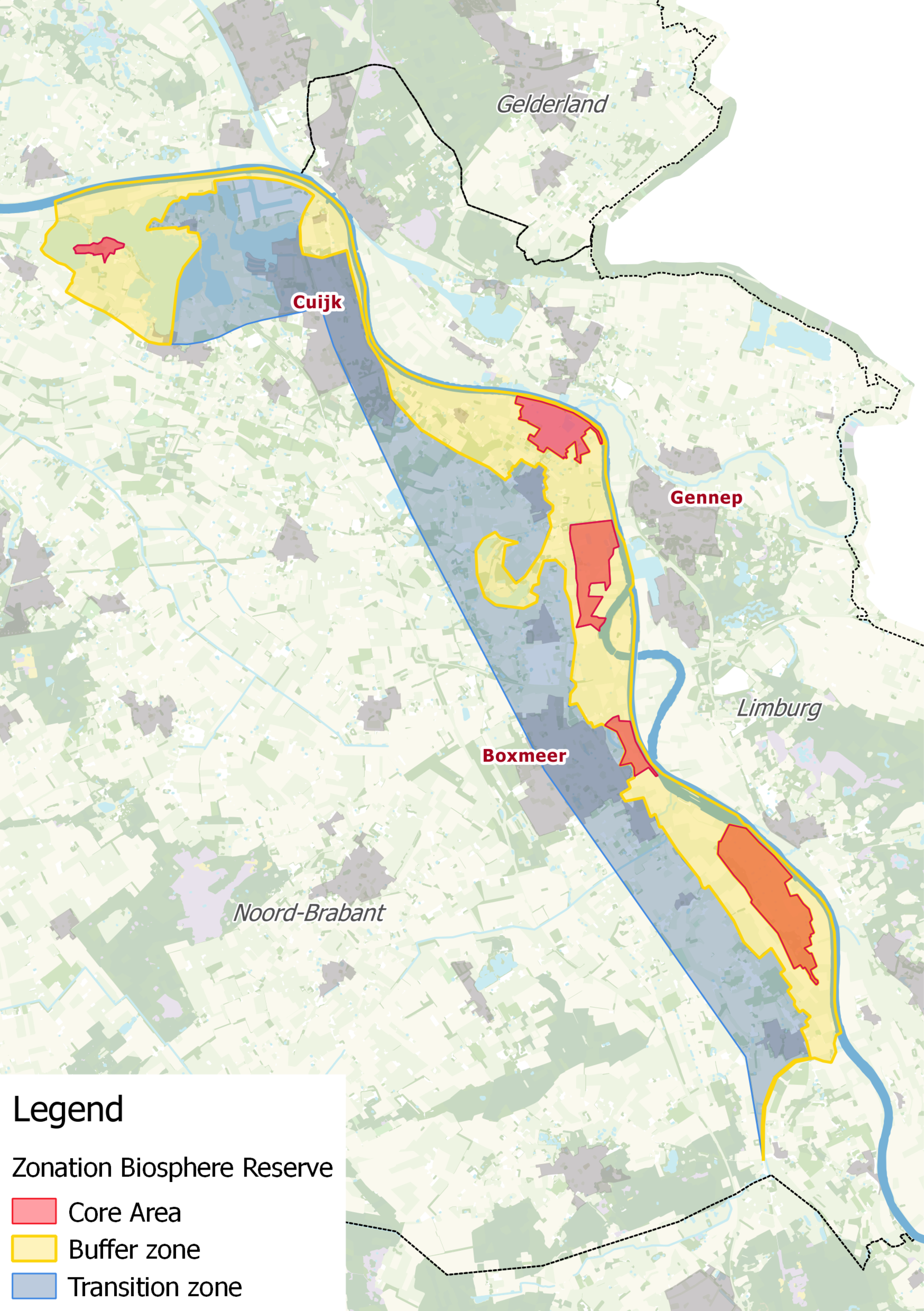
The map published here provides insight into the current delimitation and zoning of the Unesco Biosphere Reserve De Maasheggen.
In a Unesco Biosphere Reserve, zones indicate different uses and protection of the area.
The core zone (red) is a protected area for conservation of biodiversity, ecosystems and genetic diversity.
The buffer zone (yellow) surrounds the core zones and allows activities appropriate to ecological management.
The transition zone (blue), the outer zone, is an area for sustainable development, where economic and social activities take place while respecting nature.